

NASA’s X-59 recently achieved one of the most important milestones of its development program, reaching Mach 1.4 at 55,000 feet—the planned operating conditions for future community overflight testing. While the achievement demonstrates the aircraft’s technical maturity, the significance of the X-59 extends far beyond speed, aerodynamics, or even the aircraft itself.
The X-59 is part of a much larger effort to answer a question that has challenged the aerospace industry for decades: can routine overland supersonic flight become practical, acceptable, and ultimately viable for commercial use?
For many observers, supersonic aviation is primarily an engineering challenge. Develop more efficient engines, improve aerodynamic performance, reduce fuel consumption, and commercial supersonic travel will naturally follow. Yet history suggests the situation is more complex. The technology required to fly faster than sound has existed for decades. What has remained elusive is the ability to operate routinely over populated areas without generating the disruptive sonic booms that led to regulatory restrictions around the world.
In that respect, the X-59 may prove to be one of the most important aerospace programs currently underway. Its ultimate contribution may not be the aircraft’s performance, but the data it generates and the regulatory discussions that follow.
Beyond Concorde
The comparison to Concorde is unavoidable. More than fifty years ago, Concorde demonstrated that commercial supersonic transportation was technically feasible and operationally practical. Passengers routinely crossed the Atlantic at more than twice the speed of sound, reducing travel times and creating an experience that remains iconic in aviation history.
Despite its technical success, however, Concorde did not lead to widespread supersonic travel. One of the most significant barriers was the sonic boom generated during overland flight. Concerns about noise impacts led to restrictions on routine civil supersonic operations over land, limiting where supersonic aircraft could operate and reducing the economic viability of future programs.
As a result, the primary question facing the industry today is fundamentally different from the question Concorde answered.
Concorde demonstrated that people could fly commercially faster than sound. The X-59 is attempting to determine whether future aircraft can do so in a manner that communities find acceptable and regulators are willing to permit.
That distinction is important because it shifts the discussion from technology alone to the broader ecosystem required for commercial aviation. Successful aircraft programs depend not only on engineering achievements, but also on certification, operational economics, public acceptance, and regulatory frameworks that enable routine service.
A Regulatory-Enabling Program
Although the X-59 is often described as an experimental aircraft, it is perhaps more accurate to think of it as a regulatory-enabling program.
The aircraft incorporates shaping technologies intended to reduce the intensity of the sonic boom reaching the ground. Rather than producing the sharp double boom traditionally associated with supersonic flight, the X-59 is designed to generate a much quieter acoustic signature. NASA’s objective is not simply to demonstrate that this can be achieved, but to measure how people respond when exposed to these lower-noise events.
That distinction is critical. The ultimate purpose of the program is to generate the data necessary for future policy discussions regarding overland supersonic flight.
In practical terms, the path forward involves much more than flight testing. It requires gathering objective acoustic measurements, conducting community response studies, analyzing the resulting data, and providing regulators with the information needed to evaluate whether existing restrictions remain appropriate in light of new technologies.
The X-59 therefore represents a bridge between engineering innovation and regulatory decision-making. Without that bridge, the commercial potential of future supersonic aircraft could remain constrained regardless of technological progress.
A Decade-Long Effort
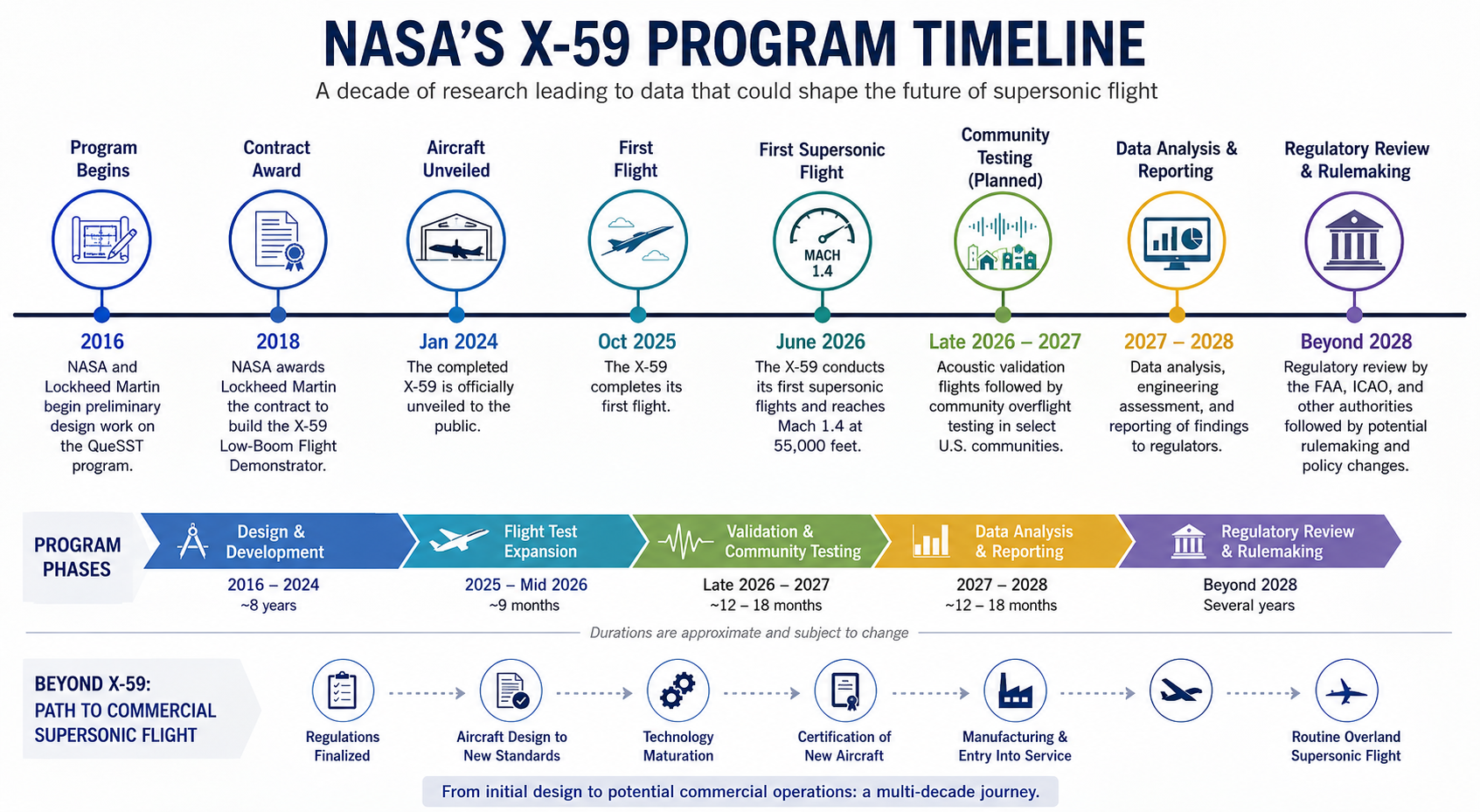
The recent Mach 1.4 milestone is only one step in a research effort that has already spanned nearly a decade and will continue for several years.
Key Program Milestones
- 2016 – NASA begins work on the Quiet Supersonic Technology (QueSST) initiative.
- 2018 – Lockheed Martin receives the contract to build the X-59 demonstrator.
- January 2024 – NASA officially unveils the completed X-59 aircraft.
- October 2025 – The aircraft completes its first flight.
- June 2026 – The X-59 reaches Mach 1.4 at 55,000 feet during supersonic testing.
- Late 2026 through 2027 – Community overflight testing and acoustic validation campaigns are expected.
- 2027–2028 – Data collection, analysis, and reporting activities.
- Beyond 2028 – Potential regulatory review and rulemaking discussions.
Viewed as a whole, this timeline highlights the long-term nature of the effort. Even after years of aircraft development and testing, the program’s most consequential phase may still lie ahead.
The industry often focuses on technological breakthroughs, yet the process of translating those breakthroughs into operational reality frequently takes much longer. In this case, the aircraft itself is only the first step in a sequence that includes public engagement, regulatory evaluation, and eventually the development of future commercial aircraft.
Why The Industry Is Paying Attention
The X-59 matters not only because of what it may accomplish, but also because of what it represents.
Major aerospace research programs require substantial investment, long planning horizons, and a belief that the knowledge generated will ultimately benefit future generations of aircraft. NASA’s continued commitment to supersonic research demonstrates that faster global transportation remains an important long-term objective for the aerospace community.
Historically, transformative advances in aviation have emerged from similar investments. Jet transport, fly-by-wire flight controls, advanced composite structures, satellite navigation, and modern propulsion systems all required years of experimentation before becoming commonplace. In each case, the benefits extended well beyond the original research programs.
Supersonic aviation is following a similar path. The knowledge generated by the X-59 will likely influence future aircraft designs, certification strategies, operational concepts, and regulatory discussions across the industry.
That is why companies, regulators, researchers, and aviation stakeholders are paying close attention to the program’s progress.
Every Outcome Provides Value
One of the strengths of the X-59 program is that meaningful knowledge will emerge regardless of the outcome.
If community testing confirms expectations, regulators will have access to objective data supporting future discussions about overland supersonic operations. If the results reveal challenges that remain unresolved, the industry will gain a clearer understanding of the technical, operational, or societal issues that still require attention.
Both outcomes move the industry forward.
Aviation has always advanced through disciplined experimentation, rigorous measurement, and a willingness to learn from both successes and setbacks. The X-59 continues that tradition by addressing one of the most important unanswered questions in modern aerospace.
The Long Road Ahead
Even after community testing is completed, significant work will remain before routine overland commercial supersonic travel becomes possible.
Future steps are likely to include:
- Analysis of community response data.
- Review by the FAA, ICAO, and other regulatory authorities.
- Development of potential noise standards and operational requirements.
- Formal rulemaking activities.
- Design, certification, production, and entry into service of future commercial aircraft.
Each phase may require years to complete, which is why the path toward widespread supersonic travel should be measured in decades rather than months.
The timeline graphic accompanying this article illustrates that progression clearly: technology leads to data, data informs regulation, and regulation ultimately enables commercial aviation.
Looking Forward
Commercial supersonic travel will not become widespread overnight. Achieving that goal will require continued advances in aerodynamics, propulsion, materials, operations, economics, certification, and public acceptance. It will also require regulators to have confidence that future aircraft can operate responsibly within the communities they serve.
That is why the X-59 matters.
Concorde proved that commercial supersonic flight was possible. The X-59 is attempting to determine whether routine overland supersonic operations can become practical and acceptable in the modern era.
The aircraft’s most important contribution may not be how fast it flies, but the foundation it helps build for the next generation of commercial supersonic transportation. Every flight, every measurement, and every piece of data brings the industry one step closer to understanding whether that future can become reality.